
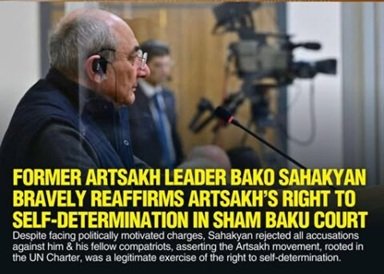
In Baku, the fabricated trial of the Artsakh leaders continued on February 27. Azerbaijani media reported this.
During the sham trial in Baku, former Artsakh President Bako Sahakyan rejected the charges against him and his fellow compatriots, reaffirming that the Artsakh movement and the right to self-determination are the legal rights of the people of Artsakh, opposition Pativ Unem faction MP Tigran Abrahamyan reported..
The lawmaker said Sahakyan essentially argued that the Karabakh movement, which began in 1988 and was based on the relevant article of the Soviet Union’s constitution and the principles enshrined in the UN Charter, was a legitimate exercise of the Artsakh people’s right to self-determination.
“Rejecting the charges against him, Bako Sahakyan claimed before the court that neither he nor his fellow compatriots facing trial under this article had committed any illegal and criminally punishable act,” Abrahamyan wrote.
The Azerbaijani media reported that Arkady Ghukasyan, David Ishkhanyan, and David Babayan also gave some testimonies.
Former Artsakh President Arkady Ghukasyan said that the Republic of Armenia was acting as the guarantor of Karabakh. “Of course, given the plenty of unresolved issues, the small Karabakh could not successfully organize its defense on its own until the conflict was resolved.”
He said that he was in Karabakh during the 44-day war in 2020. “It happened at the time when I arrived in Karabakh. Almost on the second day of the war, together with another “former president” Bako Sahakyan, I requested a meeting with Arayik Harutyunyan.
We met with him. We asked him to use all the opportunities at his disposal to ask Armenia to stop the war.”
Arkady Ghukasyan claimed that there were no mercenaries in Karabakh’s territory. “There was the Ministry of Defense and the Armenian army, which was financed by the Republic of Armenia.”
Artsakh NA Speaker David Ishkhanyan and former Foreign Minister David Babayan have stated that they are not guilty of the accusations.
Arayik Harutyunyan was offered to testify, but he asked for additional time from the court to prepare for it.
Meanwhile, Armenia’s Foreign Ministry has condemned Azerbaijan’s staged trials and severe procedural violations, reaffirming its efforts to secure the release of Armenian prisoners of war, hostages, and detainees.
The next session was held on March 3. The Azerbaijan State News Agency AZERTAC reports the following as to what transpired at the session:
The court session saw testimony from the accused Lyova Mnaksakanyan, Arayik Harutyunyan, Erik Ghazaryan, and Vasili Beglaryan.
In his testimony, the accused Lyova Mnaksakanyan confirmed his participation in the war against Azerbaijan as part of the Armenian regular army. He said that a secret decision had been made on 20 September 2020 of which he was unaware. He said, “I participated in the war against Azerbaijan as part of the Armenian regular army. I don’t want to talk any further as to what the order was about. You all know that. In general, after I was discharged from the military service, I didn’t have any contact with the army. I was not interested for family and other reasons. In addition, we were forbidden to maintain any contact with the army. In particular, the Prime Minister of the Republic of Armenia forbade us to talk to or stay in touch with anyone.”
Lyova Mnaksakanyan also spoke about the battles of April 2016, noting that Armenia had provided the “self-styled regime” with weaponry. “There was no need for me to be involved in the 2016 operations. If there had been, of course, I would have been involved. We had a great deal of tactical, reconnaissance weapons and radio-electronic devices, some of which were available in Armenia. We got those weapons from Armenia. Finally, I want to state that if the high command gives us something, we must allocate staff and attract personnel for that.”
Speaking next was the accused Arayik Harutyunyan. In his statement, he spoke about what happened in the run-up to the 44-day war. “In June 2020, I asked Pashinyan to familiarize us with the process of negotiations. In June 2020, a meeting of the joint Security Council was held in Yerevan. The meeting was open to everyone. During that meeting, the then Minister of Foreign Affairs of Armenia introduced us to the negotiation process. It was clear that this process was at an impasse. During the meeting, the heads of the Armenian defense agencies familiarized us with the situation in the army. It became clear that Armenia was not ready for war. War requires certain resources. In particular, food, weapons, and financial resources were needed. It turned out that Armenia did not have the resources to wage war. I expressed my opinion there quite briefly. I stated that the outcome of the war would hinge on our resources. After all, any war is a war of resources. The potential of Azerbaijan in all areas was many times superior to that of Armenia.
“Then, in July, as you know quite well, there were shootings in Tovuz [Tavush] at the time. I had no idea what was happening there. I only know what they showed on TV. Since I was a new person, I had to get acquainted with the situation in the army and find out what was going on there on the line of contact. In the summer of 2020, I started to travel to the front line and get acquainted with the army. I published several articles on my Facebook page and the leadership website. The press service provided us with all the information about the army. And they were published on my page. And yes, there have been speeches and statements of mine that I now regret that I allowed to happen.”
He stated that he observed the exercises of the Karabakh army in the summer and at the end of June of that year, acknowledging that the exercises were led by the Chief of Staff of the Armenian army, Onik Gasparyan and that the decisions on strikes deep into Azerbaijani territory had been made in Armenia. “The exercises were led by the Chief of Staff of the Armenian army, Onik Gasparyan. And this was not a secret process, but something that was in front of everyone’s eyes. At the end of the summer, Nikol Pashinyan arrived in Karabakh. I accompanied him to the army units. He got acquainted with the situation. I could see and hear what was happening in the armed forces. I had not received any information from the Karabakh defense committee. I was never provided with any information about the situation. I had no authority over the army. You know this too. This is also written about in the indictment. It has been repeatedly stated in the Armenian media that Armenia is responsible for the security of Armenians in Karabakh. The Armenian armed forces and the Karabakh defense army were also part of that. So, Armenia is responsible for security issues.
“As you know, on September 27, a large-scale war broke out. Under the laws of Karabakh, we had to declare martial law, and so we did. The parliament was informed that the war had begun. The call-up announced by the leadership of the Karabakh army began. It was clear to me what the outcome would be. From the first days, my conversation with Pashinyan boiled down to when the war would stop. I met with members of parliament regularly, almost every day. Almost every day, I met with Bako Sahakyan and Arkadi Ghukasyan. We talked about stopping the war at least a minute earlier. On October 2, I made a statement saying that I had no authority over the army and it would be best if I joined the ranks as a soldier. I left my post and went to the front line. Of course, I couldn’t be on the front line, because military operations were going on there, but I was meeting with soldiers in the rear. I didn’t want to go back. I knew what would happen. But at the insistence of my colleagues and friends, I went back. On that day, the decision was made to strike military facilities deep inside Azerbaijan using rocket or artillery installations. The political and military vertical essentially started with the chief of staff of the Karabakh defense army, from the top down. It is clear to me from the statement given by Levon Mnatsakanyan a little earlier that the investigation is aware of what powers he had and what he could do. I didn’t know who had what powers, what weapons should be used, what would be done, and so on. When I asked Onik Gasparyan if these decisions were justified, he told me yes, Azerbaijani airports were our primary targets and we must destroy those targets. It has been ordered that we should create the impression that these strikes are being carried out from Karabakh.”
Arayik Harutyunyan said that he wanted to address a letter to the President of Azerbaijan Ilham Aliyev, but Armenian Prime Minister Nikol Pashinyan did not allow him to do that.
“On the evening of October 18, Bako Sahakyan, Arkadi Ghukasyan, and I had our last meeting. I called Nikol Pashinyan and said that I was ready to write a letter to the President of Azerbaijan about stopping the war, adding that Bako and Arkadi were ready to join in if necessary. The essence of the letter was simply about stopping the war. The content of the letter we wrote to Pashinyan was that you should stop the war in any way and state that this is the desire of the Armenian people. There was no unified opinion in Armenia, so I said that he could refer to us in asking that the war be stopped. We are ready to allegedly plead guilty afterward, but human lives must be saved. Pashinyan held several meetings and met with the opposition and almost everyone else. At the end of October 19, he called me back and said that the war would go on. I don’t want to go into further detail, but the worst thing was that the war was going on.”
Arayik Harutunyan admitted that the commander of the Karabakh defense army reported to the Chief of the General Staff of the Republic of Armenia. “I did not appoint or dismiss the military commander because I did not have the authority to do so. The Karabakh army had not functioned as a separate army for decades. A criminal case has been initiated against the commander of the Karabakh army in Armenia. If they had reported to me, a criminal case would have been initiated against it in Karabakh,” he said.
The accused Erik Ghazaryan said in his statement that he did not kill anyone and surrendered because he did not want to fire on Azerbaijani soldiers.
In his statement, the accused Vasili Beglaryan said he did not plead guilty to the charges brought against him.
The next court hearing is scheduled for March 6.