
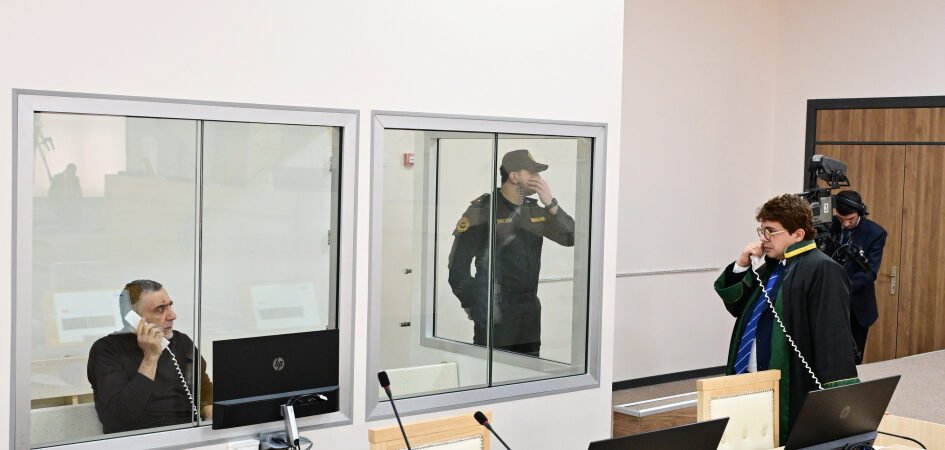
Former Artsakh State Minister Ruben Vardanyan on Tuesday, February 25, became ill in a military courtroom in Baku during his sham trial. Vardanyan last week announced that he was going on a hunger strike to protest what he called a “judicial farce.”
Vardanyan’s sudden worsening condition prompted the court to halt the proceedings to provide a medical examination. The trial resumed following the brief recess, according to the state-run Azerbaijani press.
Following the recess, Vardanyan reportedly refused to offer any testimony regarding the more than 45 charges being levied by Azerbaijani prosecutors.
The Azerbaijani state-controlled media reports:
“The accused was offered the opportunity to give a free statement, but he refused.
“After that, the prosecutors in charge of the state prosecution began to ask the accused questions about the criminal acts he was accused of.
“The Senior Assistant to the Prosecutor General, Vusal Aliyev, asked the accused R. Vardanyan about his attitude towards the occupation of the sovereign territories of the Republic of Azerbaijan as a result of Armenia’s military aggression, the forcible deportation of Azerbaijanis, the torture and killing of prisoners and hostages, the infliction of material damage on the Republic of Azerbaijan, and other facts.
“The Head of the Department for the defense of Public Prosecution of the Prosecutor General’s Office, Nasir Bayramov, prosecutors Fuad Musayev and Vusal Abdullayev asked the accused about the events that sparked off the occupation of the sovereign territories of Azerbaijan, his relations with citizens of the Republic of Armenia Arayik Harutyunyan, Arkadi Ghukasyan, Bako Sahakyan, Davit Ishkhanyan, Davit Babayan, Lyova Mnatsakanyan and Davit Manukyan, the ‘Aurora Humanitarian Initiative Fund’ operating under the guise of humanitarian goals, the reasons for his renouncing the citizenship of the Russian Federation and accepting the citizenship of the Republic of Armenia.
“Questions were also asked about his relations with Robert Kocharyan, Serzh Sargsyan, Samvel Babayan, Vitali Balasanyan, Zori Balayan and others.
“The Assistant to the Prosecutor General for Special Assignments, Tugay Rahimli, asked the accused about the procedure for his appointment as so-called state minister of the self-styled regime, about who provided the guarantees for his appointment to the position, about the identity of the people he consulted in this regard, about the territories of the Republic of Azerbaijan he traveled to that were previously under occupation, about the activity directions of the “We and Our Mountains Territorial Development Agency” and the “Artsakh Security and Development Front Movement”.
“Then, R. Vardanyan’s interview attached to the criminal case file was examined in the presence of an interpreter.
“Public prosecutors asked the accused questions about a number of aspects of the interview, including his illegal entry into Karabakh, the sovereign territory of the Republic of Azerbaijan, through the territory of Armenia, the currency in circulation on the territory of the so-called regime, the reason for using the passport of the Republic of Armenia on the territory of the so-called regime, the goals and grounds for the deployment of the armed forces of the Republic of Armenia there, the reasons and goals of R. Vardanyan’s statements about the impossibility of a coexistence between the Azerbaijani and Armenian peoples, as well as his incitement of hatred and enmity between the two peoples, forms of financing of the so-called regime and the participation of the Armenian state in this process, and reasons for the short term of his tenure as ‘state minister’.
“The accused Ruben Vardanyan did not answer any of the questions put to him.”
The trial will resume on March 4.
Vardanyan, who was captured along with other Artsakh leaders in the days following the brutal Azerbaijani attack in September 2023 that led to the forced displacement of Artsakh’s Armenian population, is being tried separately and is facing upward of 45 charges.
His trial began last month. However, his pleas to be allowed to review the charges with his attorney have been continuously denied by the presiding judge in the case.
Vardanyan’s trial is being held behind closed doors, with only the state-run Azerbaijani press disseminating identical information after each court session.
Earlier this month, Vardanyan was charged with allegedly plotting the assassination of high-level Azerbaijani officials, in what the court termed “Operation Nemesis 2.0.”
In announcing his hunger strike on February 19, Vardanyan said, “What is happening in the courtroom cannot be called a trial – this is a political show, in which my right to a fair hearing is being deliberately disregarded.”
“Sadly, it has been clear from the beginning that this case is all about persecuting me as an Armenian simply for exercising my rights to freedom of opinion and expression and political participation under international law, which have been aimed at protecting the rights of the Armenian-Christian population of Artsakh,” Vardanyan emphasized last week.
He listed the following ways to describe how his trial has been “replete with egregious abuses of due process.”
- I am being tried in an illegal military tribunal and not a civilian court.
- I have not been granted full access to the indictment and so-called “evidence” against me – 422 volumes in Azerbaijani, for which I was given only 21 working days to review, which have been classified as “state secrets.”
- The “indictment” presented to me is not an official document, as it lacks the signatures of my accusers. Even the translation of this so-called document contains gross errors, making it impossible for me to understand the charges against me.
- I have been denied my right to defense – my local lawyer, Avraam Berman, has had his access to materials restricted, his documents confiscated, and he has been subjected to psychological pressure. Further, my international legal team has been barred from communicating or visiting me and has not had access to any of the case materials
- I have not been allowed to summon defense witnesses or file complaints regarding the violations committed during the investigation and trial.
- All of the hearings have been secret and closed to the public. Foreign journalists and independent international representatives have been barred from the courtroom.”