
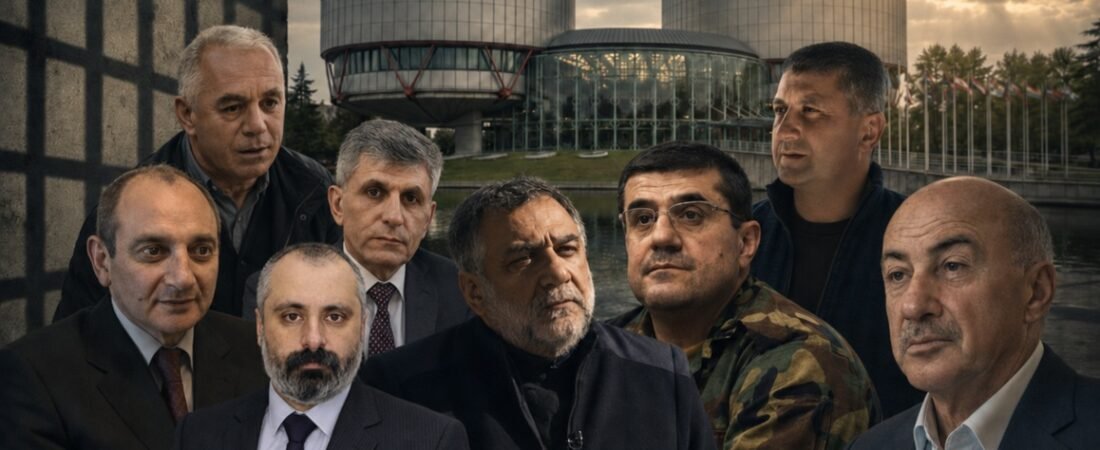
In separate interviews with News.am and Sputnik Armenia, human rights lawyer Siranush Sahakyan outlined the legal action being pursued before the European Court of Human Rights over the imprisonment of Armenians in Azerbaijan, while warning that the detainees remain almost entirely isolated from independent international oversight.
Sahakyan, who heads the Center for International and Comparative Law and is the director of the Armenian Legal Center, represents the interests of Armenian captives before the European Court of Human Rights, confirmed that a formal complaint concerning former Artsakh State Minister Ruben Vardanyan has already been submitted to the ECHR. Additional applications are also being prepared in connection with reports that some of the Armenian prisoners have suffered serious injuries, including fractures that may have resulted from violence.
Vardanyan Complaint Submitted to the ECHR
Vardanyan was sentenced to 20 years in prison by a Baku court in February 2026 after proceedings that Armenian officials, lawyers and international human rights advocates have denounced as politically motivated.
He declined to appeal the judgment within Azerbaijan’s judicial system, regarding any continuation of the proceedings as participation in a judicial farce. Appeals filed on behalf of fifteen other Armenian prisoners are being considered by the Azerbaijani courts, although Sahakyan said there was little prospect of the original verdicts being overturned.
“In the case of the fifteen, it is predictable that the military court’s verdict will be upheld. No court in Azerbaijan can serve as a mechanism for protecting the violated rights of ethnic Armenians, especially when dealing with any matter related to the Nagorno-Karabakh conflict.
“As for Ruben Vardanyan’s case, the complaint has already been submitted to the ECHR, since it is impossible to protect rights within a system that from the outset rejects justice and rights, and where the trial is a ceremony for carrying out the executive branch’s political decisions. Through the family, we gained access to the verdict, which was translated into English and submitted along with the relevant documents. We expect that the ECHR, in accordance with its procedures, will proceed with the complaint.”
The judgment obtained by Vardanyan’s family gave his legal representatives their first opportunity to examine the complete document. According to Sahakyan, its contents help explain why the proceedings were conducted behind closed doors and without access for international observers or foreign media.
“Yes. And after that, it immediately became clear why the sessions were held behind closed doors, without the participation of international observers and international media representatives. Having reviewed the verdict, it is obvious that during the more than one-year preliminary investigation and the one-year trial, they actually failed to find any reasoning even remotely close to logical for the “charges” they themselves had invented. We are dealing with an unprofessional, fragmented document that cannot withstand any professional criticism whatsoever, called a “verdict,” on the basis of which our compatriots are, in essence, being held as illegal hostages in that country.”
Allegations Not Linked to Individual Conduct
The ECHR complaint raises violations of eight provisions of the European Convention on Human Rights, including the right to a fair trial under Article 6. Sahakyan said the violations affected all three paragraphs of that article and undermined the legitimacy of the entire judicial process.
The application also raises alleged discrimination and the restriction of rights for political purposes.
Vardanyan was declared guilty on 41 counts under 21 articles of Azerbaijan’s Criminal Code. Sahakyan said, however, that the judgment failed to establish his individual responsibility through specific facts or evidence.
Instead, the Azerbaijani court characterized the governing institutions of Artsakh as a “criminal community” that had allegedly operated since 1988. It then concluded that Vardanyan had joined that community in December 2020, despite the fact that he was living in Moscow at the time.
His subsequent support for Artsakh’s institutions was used to attribute to him responsibility for alleged offenses said to have occurred over several decades. These included killings, attempted killings, forced displacement, disappearances, torture and hostage-taking, including incidents predating both his residence in Artsakh and his assumption of public office.
The activities more directly associated with Vardanyan concerned his tenure as State Minister of Artsakh from November 2022 to February 2023 and his public activities between May and September 2023.
The Azerbaijani court characterized his appointment as State Minister as a “violent seizure of power,” described his commercial and charitable work as “illegal entrepreneurship and financing of terrorism,” and treated his entry into Artsakh through the Lachin Corridor as an illegal crossing of Azerbaijan’s border.
The judgment reportedly identifies no specific instruction by Vardanyan to kill, torture, displace or attack civilians and provides no evidence of his personal participation in the offenses attributed to him.
Confidence in the International Legal Process
Sahakyan acknowledged the broader difficulties associated with securing the implementation of judgments and resolutions by international institutions. Azerbaijan has ignored numerous calls from the Parliamentary Assembly of the Council of Europe, the European Parliament and other international bodies, as well as legally binding orders issued by the International Court of Justice.
Nevertheless, she warned against abandoning international legal mechanisms or underestimating their long-term significance.
“Of course, it is painful to acknowledge that in the current situation, international law, fundamental human rights, and democratic values are being subordinated to geopolitical interests. But in my conviction, the legal dimension should not be underestimated, and even more so, one should not lose hope or stop fighting. I personally, as a lawyer, place great importance on international legal processes. I am confident that their results will not remain without consequence sooner or later, and I am more than convinced that we have every basis for achieving a positive outcome at the ECHR.”
New Applications Being Prepared Over Health Concerns
In her interview with Sputnik Armenia, Sahakyan also addressed reports that some of the Armenian prisoners have suffered serious injuries, including bone fractures that may have resulted from violence.
She confirmed that applications were being prepared in connection with the issue but said it would not be appropriate at this stage to disclose when they would be submitted or which institutions would receive them.
The central difficulty is the absence of objective and independently verifiable information concerning the prisoners’ health, treatment and conditions of detention.
Until September 2025, information could be obtained through visits by the International Committee of the Red Cross. That channel disappeared after Azerbaijan terminated the ICRC’s activities in the country.
“We are talking about their complete isolation from the outside world, where there is no physical contact with international independent monitoring missions, independent lawyers, independent doctors or consular officials. Under these circumstances, their conditions can only be observed and information about them collected from Azerbaijani sources, which are unreliable and, most importantly, unverifiable. In other words, whatever picture is presented cannot be verified by independent, objective and impartial actors because access to the Armenian hostages is restricted,” Sahakyan said.
In the absence of international monitoring, telephone conversations with relatives have become virtually the only source of information. Those conversations are monitored by the Azerbaijani authorities, and prisoners are not allowed to make calls at consistent intervals.
According to Sahakyan, the differences in access indicate discriminatory treatment. Some detainees may be permitted to call their relatives once a week, while others may have to wait four or six weeks.
“Moreover, this has varied throughout the period of captivity. For example, there have been cases when, during the initial period, families were unable to speak with their relative for weeks or months, or the interruptions coincided with various events or holidays there, and once again the regular frequency of calls was not maintained,” Sahakyan said.
Azerbaijan Required to Report by August 31
Azerbaijan is required to submit information to the ECHR by August 31 concerning the Armenian prisoners’ health and conditions of detention, including relevant medical records.
Sahakyan cautioned that the submission of documents would not itself guarantee that the information was complete, accurate or unaltered. Human rights lawyers will compare Azerbaijan’s report with information gathered from the prisoners’ relatives and other available sources.
“This is the formal fulfillment of the state’s obligation, but how conscientious and complete that fulfillment is becomes a matter for subsequent consideration. If we see incomplete information or data that do not correspond to reality, we inform the court, and the court will draw the appropriate conclusions during its examination of the case,” Sahakyan said.
She assessed the prospects for a full resumption of ICRC activities in Azerbaijan as limited. A more realistic possibility could be an agreement permitting one-time humanitarian or medical visits, although efforts in that direction have not yet produced tangible results.
Possible alternatives could include a visit by an independent medical delegation or an arrangement under which a neutral third country conducts consular visits on Armenia’s behalf.
Sahakyan pointed to Switzerland as an example of a neutral state potentially prepared to undertake such a humanitarian mission. Such visits would, however, require an agreement between Armenia and Azerbaijan and, ultimately, the consent of the Azerbaijani authorities.
“If such consent is not given, it will later be much more difficult for them to refute allegations of torture,” the human rights advocate added.
Requests by the prisoners’ relatives to travel to Baku and visit them have likewise produced no publicly known results. Appeals have reportedly been addressed to the Azerbaijani and Armenian authorities, as well as to foreign governments and organizations capable of assisting with such a humanitarian mission.
Armenian Prisoners Serving Lengthy Sentences
According to official figures, Azerbaijan is holding 19 Armenian prisoners.
The proceedings against former members of Artsakh’s military and political leadership began in Baku in January 2025. Verdicts were announced in February 2026 following closed proceedings condemned by Armenian human rights advocates as fundamentally unfair.
Former Artsakh President Arayik Harutyunyan, former National Assembly Speaker Davit Ishkhanyan, former Defence Army Commander Levon Mnatsakanyan and former Deputy Defence Army Commander Davit Manukyan were sentenced to life imprisonment.
Former Artsakh presidents Arkadi Ghukasyan and Bako Sahakyan were sentenced to 20 years in prison.
Civilian prisoners Madat Babayan and Melkiset Pashayan received 19-year sentences; Garik Martirosyan was sentenced to 18 years; Davit Alahverdyan and Levon Balayan received 16-year terms; and Erik Ghazaryan, Gurgen Stepanyan and Vasily Beglaryan were sentenced to 15 years.
Vardanyan’s case was considered in separate proceedings. His 20-year sentence was reported on February 17. On April 28, he was reportedly transferred, together with other Armenian prisoners, to the Umbaki prison complex in Baku’s Garadagh district.
With independent lawyers, doctors, humanitarian organizations and consular representatives denied access, the prisoners’ actual health and treatment remain impossible to verify. Their representatives are therefore continuing parallel legal and diplomatic efforts aimed both at securing independent access and ultimately obtaining their release.