
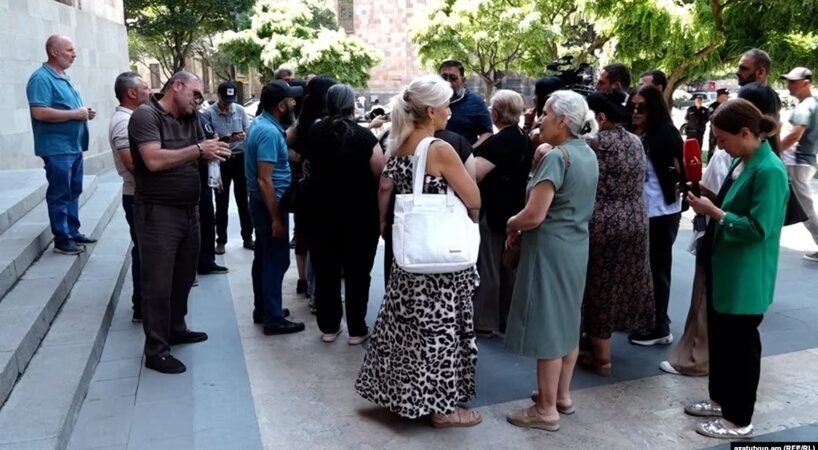
The parents and relatives of servicemen who went missing during the 44-day war are warning the Armenian government that if officials refuse to meet with them and answer their questions, they will travel to the Armenian-Azerbaijani border next week and appeal directly to the Azerbaijani authorities.
Aida Karapetyan, who has been searching for her son since 2020, says she saw him in an Azerbaijani video released after the war. Her son, who had volunteered to join the front, was portrayed by the Azerbaijanis as a terrorist. For years, she has insisted that he is alive and being held captive. However, his name does not appear on the published lists of Armenians held in Azerbaijan.
“They took him away. My demand is this: how can they say my child ‘isn’t here’? We will gather together, several parents, and go to the Hakari Bridge,” Aida Karapetyan said.
Four days ago, the parents and relatives of the missing gathered outside the Armenian government building, demanding information about their loved ones. No representative of Prime Minister Nikol Pashinyan’s government approached them. Four days later, officials have still not responded to the parents’ warning that they intend to travel through Syunik Province to the Azerbaijani border.
RFE/RL’s Armenian Service contacted Armenia’s National Security Service (NSS) to ask whether it had offered to meet with the parents. The agency did not answer the question, instead requesting that the inquiry be submitted in writing.
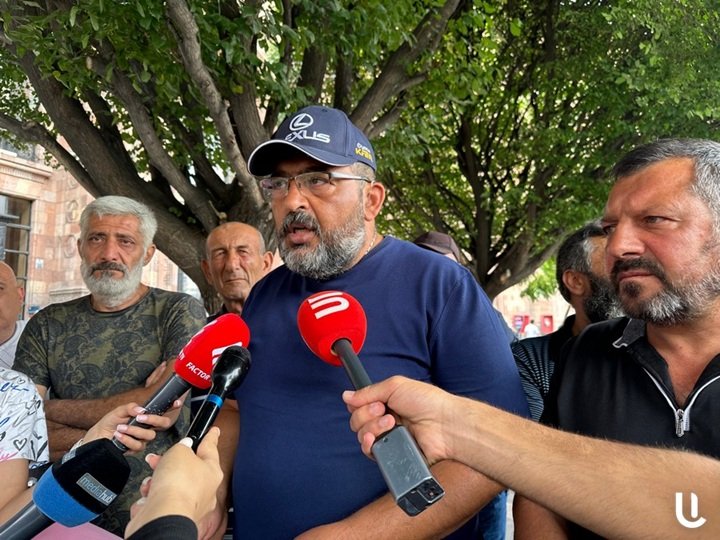
The desperate relatives say they will wait only a few more days and then, on Monday or Tuesday, head toward the Hakari Bridge, which is now under Azerbaijani control. Arsen Ghukasyan, who is searching for his missing nephew, told RFE/RL’s Armenian Service that they are determined to proceed. Ghukasyan also lost his brother in the same war.
“We have reached the point where we are ready for anything. If the authorities are doing nothing, what else can we do?” he said.
For six years, the parents searching for their children have repeatedly staged protests outside government institutions, demanding that the authorities—who speak of achieving peace between Armenia and Azerbaijan—take concrete steps and provide any information about their missing sons and relatives.
“They keep saying they’re working on it. Other than that answer, we’ve heard nothing,” Aida Karapetyan complained.
Twenty days ago, the families requested a meeting with Secretary of the Security Council Armen Grigoryan, who met in Dilijan in June with Hikmet Hajiyev, an aide to Azerbaijani President Ilham Aliyev. The families hoped to learn whether Grigoryan had raised the issue of the missing Armenians with the senior Azerbaijani official. According to Aida Karapetyan, however, Grigoryan never met with them.
Siranush Sahakyan, a member of the Interagency Commission on Prisoners of War, Hostages, and Missing Persons, believes that efforts to locate the missing can only be effective and credible with the involvement of international organizations.
“Our position is that the solution lies in intensifying search mechanisms and establishing mechanisms for the exchange of information,” Sahakyan emphasized.
According to her, Azerbaijan officially responds to international inquiries on the matter by stating that it is prepared to cooperate if the families of the missing agree to provide DNA samples. Azerbaijani authorities say they will compare those samples with the information in their database and, if a match is found, return the remains or the body.
Recently, the Azerbaijani authorities announced plans to establish a unified platform containing information on missing persons. The platform would allow citizens of both Armenia and Azerbaijan to anonymously report missing individuals, including possible burial sites. The Armenian authorities have not yet issued any public response to the initiative, and it remains unclear when or how the platform will become operational.
Following the 44-day war, the Armenian side has raised the issue of approximately 200 missing persons. It also continues to seek information about an additional 900 individuals who disappeared during the First Nagorno-Karabakh War. Azerbaijan, for its part, says that around 4,000 people went missing during the First Karabakh War. According to the Azerbaijani authorities, those individuals disappeared during that conflict.
Gayane Saribekyan/Azatutyun.am