
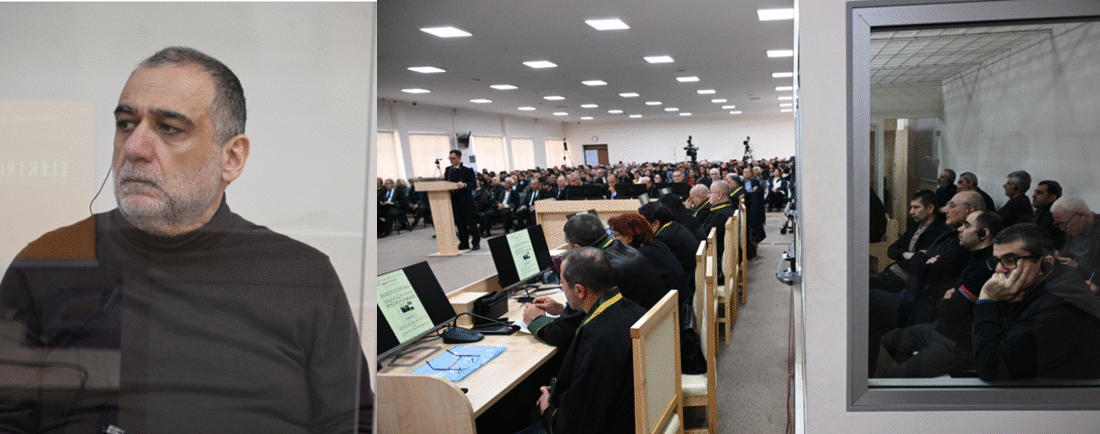
The trial of former Nagorno-Karabakh State Minister Ruben Vardanyan is expected to reach its final stage in two to three weeks, after which the prosecution will announce the requested punishment, attorney Siranush Sahakyan told NEWS.am.
According to Sahakyan, who represents Armenian prisoners at the European Court of Human Rights, court hearings in the case of the 15 Armenian prisoners are being scheduled and conducted much faster than in Vardanyan’s case. “For example, hearings for all of them are scheduled every two or three days, while in the case of Ruben Vardanyan, hearings take place every 7–9 days,” she said.
“If for the 15 prisoners we have more than 100 hearings, in Ruben Vardanyan’s case, the number is 50. However, given that most of the evidence has already been examined, we believe that in two or three weeks, Ruben Vardanyan’s case will also enter the final phase, and the prosecutor will present the indictment and specify the type of punishment sought.
“Before the verdict, the defense must also be heard. It will be interesting to hear the statements of representatives from the Public Defender’s Office, and there is also the guaranteed right to the last word, which will be given to all Armenian defendants. Only after hearing the last word can the court retire to the deliberation room.
“A person may also refuse the opportunity to give the last word; we must observe and see what the Armenians’ behavior will be,” she added.
Speaking about the prospects for the return of Armenian prisoners, Sahakyan stressed that political processes are decisive. She noted that the Armenians in custody are effectively political prisoners and hostages, and their release largely depends on the degree to which political demands are met. “The issue is politicized, and we cannot respond to the situation solely through legal mechanisms. However, legal tools still retain their importance and viability.”
If political agreements fail to secure the prisoners’ return, the legal path remains an alternative, Sahakyan said. International judicial bodies have the authority to determine whether trials have been fair and whether they provide legitimate legal grounds for deprivation of liberty. If they find that proper procedures were not followed, courts may also rule that the right to personal freedom has been violated and demand the release of those unlawfully detained.
She stressed that Armenians are precisely in such a situation, “because there are no real legal grounds for keeping them in custody. These trials are creating fabricated grounds to hold them in Baku and extract new concessions from the Armenian authorities in exchange for their release.”
“In my assessment, the issue must be resolved quickly through political channels with international involvement,” Sahakyan concluded.